PROGRAMS
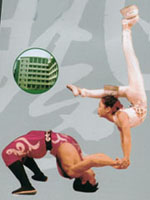
acrobatics The courses of acrobatic major focus
on the circus skills of flexibility, tumbling and handstanding, based on which
students will master the advanced skills of controlling bodies and apparatuses,
including aerial tissue, tightrope walking, hoops, cycling, bowl/cup balancing,
poles, equilibrium, contortion,
pyramids, German wheels, Russian bars, ... all those you
can find in a modern circus.
 acrobatics training classes play video (18 MB)
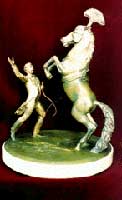
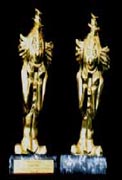
Performers graduated from the school accomplished
great achievements. They have won over 20 golden prizes from
international and national circus festivals, and have been performing
in over 50 countries across the world. Many students from north America, south America
and Europe have graduated from the School and became professional
performers as well as golden prize winners.
The Acrobatic Major has six days of study in every week, including four days
of specialty training and two days of academic study. The daily schedule for
each of the four training days is:
6:30am - 7:30am, early morning exercises
8:30am - 12pm, morning classes
2:30pm - 5pm, afternoon classes
6:30pm - 8:30pm, evening classes (optional for international students)
Domestic students need to attend the academic classes for two days a week.
International students are not required to attend. Meanwhile, you can choose
to attend Chinese language class or classes offered by other departments as
the minor during those two days if you would like to.
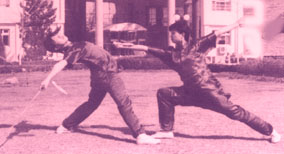
martial artsThe martial art major focuses on
the Chinese kongfu. Master Men Hui Feng, one of the top ten kongfu masters in
China is teaching at the school. After mastering various fighting skills, students
graduate with the certificates of Second Level Kongfu Master and above. Graduates
mostly are hired as martial art coaches and kongfu movie actors and actresses.
We have two kinds of categories of kongfu: one is all kinds of series. The
other competition fighting. Each individual kongfu series is dozens of basic
moves connected together, making a flowing, stunning, continuous kongfu moves.
There are hundreds of kongfu series, among which we choose tens of them to teach.
Kongfu series also have different styles. For example, some are armed, some
are un-armed. Unarmed ones are the connects the moves of fists, palms, fingers,
feet, elbows and knees with jumps, tumbles, spins, etc. Armed ones each maneuvers
a weapon. Such series are usually seen in action movies.
The competition fighting includes Chinese kongfu and Taekundo. Students can
not only learn self-defense skills but also will be able to attend major sport
competitions after fully trained.
The Martial Art Major has five days of study in every week. Each day has a
half day of specialty training and the half day of academic study.
Domestic students need to attend the academic classes. International students
are not required to attend. Meanwhile, you can choose to attend Chinese language
class or classes offered by other departments as the minor for the other half
of the day.
dance
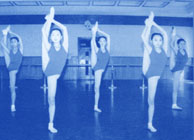
Traditional Chinese dancing embodies
the essence of Chinese acrobatics and kongfu. Students learn bodily rhythms,
skills, folk dances, modern dances, musicals and chorography. Gradates become
professional dancers.
Dance Department offers courses which includes (but not limited to) ballet,
contemporary dances, Chinese classical dance, Chinese folk dance, dance musicals
(theater), chorography and directing, music, etc. It also has courses which
specialize in more detailed skills, such as body movements, body agility, etc.
The Chinese Dance Major has five days of study in every week. Each day has
a half day of specialty training and the half day of academic study.
Domestic students need to attend the academic classes. International students
are not required to attend. Meanwhile, you can choose to attend Chinese language
class or classes offered by other departments as the minor for the other half
of the day.
Chinese languageThe training is given in Chinese language. Because most of the training are physical,
body languages are effectively used in courses. To help students learn Chinese, we offer
Chinese language courses free of charge, usually twice a week, each 45 minutes long.
class size
For a special skill, usally the class size is from 2 to 5. Students get good individual attention
and instructions from the teacher.
For basic physical training, such as handstand and tumbling, the class size is about 10 to 15.
In such classes, experiences peers can illustrate the keys of the body movements.
school calendar
Acrobatics Department
The Acrobatics Department has no summer break or spring break. It has only a two-week break following the Chinese New Year
in February.
Short breaks that last for one to five days each are available during national holidays, such as January 1st, May 1st and October 1st.
Departments other than Acrobatics
The Departments other than Acrobatics have a 40-day spring break starting from the end of January and a 60-day summer break in July and August.
Short breaks that last for one to five days each are available during national holidays, such as January 1st, May 1st and October 1st.
summer term
The summer term is July and August of each year. Only the Acrobatics Department keeps training
during the summer. Other departments have a summer break.
For students majoring in acrobatics and paying yearly tuition, no additional tuition is required.
Students can opt in or opt out the summer term study, without the change in tuition.
|